Natural IUI Cycle vs Stimulated IUI: Which Gives Better Results?
April 9, 2026 | Last updated: July 22, 2026 | Medically Reviewed by: Dr. Munawwer Sana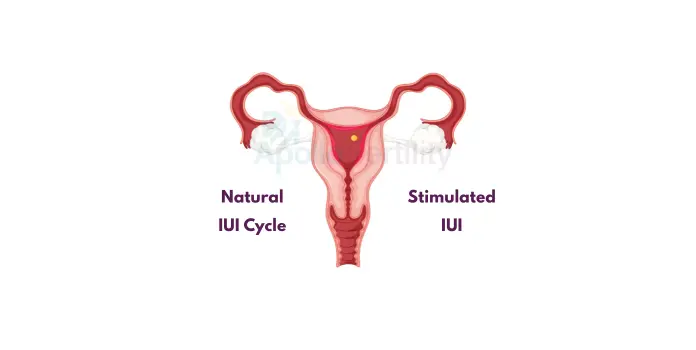
When your doctor recommends IUI (Intrauterine Insemination), one of the first decisions to make is whether to do it in a natural cycle or with the help of ovarian stimulation medication. Both approaches have their advantages and limitations, and the right choice depends on your individual diagnosis, age, and how your body responds.
We carefully evaluate each patient before recommending the most appropriate IUI protocol. Here is a clear explanation of both options to help you understand what each involves.
What Is a Natural Cycle IUI?
In a natural cycle IUI, no fertility medications are used to stimulate the ovaries. Instead, your body's natural hormonal cycle is monitored closely through blood tests and ultrasound scans to detect when your dominant follicle is ready and ovulation is about to occur. Once the leading follicle reaches the correct size (typically around 18 to 20 mm), a trigger injection of hCG is usually given to precisely time ovulation, and the IUI procedure is performed 36 hours later.
Natural cycle IUI works best for women who have regular menstrual cycles and are ovulating consistently. It involves fewer medications, fewer side effects, and is less expensive than stimulated IUI. It is also the preferred approach for women who respond sensitively to medication.
What Is Stimulated IUI?
Stimulated IUI uses fertility medications to encourage the ovaries to produce two or three mature follicles simultaneously, rather than relying on the one egg your body would naturally release. Stimulation can be achieved with oral medications such as letrozole (the preferred agent in 2026 for most patients) or clomiphene citrate, or with low-dose injectable gonadotrophins (FSH). Careful monitoring is essential to avoid over-stimulating the ovaries.
Stimulated IUI is often recommended for women with irregular or infrequent ovulation, unexplained infertility where producing more than one egg each cycle may improve chances, or when natural cycle IUI has already been tried without success.
How Do the Success Rates Compare?
Success rates per cycle are generally slightly higher with stimulated IUI compared to natural cycle IUI — approximately 10 to 15 percent per cycle with natural IUI versus 12 to 20 percent per cycle with stimulated IUI. However, stimulation also carries a small risk of multiple pregnancy (twins or more) if more than one egg is fertilised. We monitor stimulated cycles closely to reduce this risk and will cancel or convert a cycle to timed intercourse only if too many follicles develop.
Letrozole vs Clomiphene: Which Is Better for Stimulated IUI?
Letrozole (Femara/Letroz) has largely replaced clomiphene citrate (Clomid) as the preferred oral stimulation agent for IUI in 2026, particularly for women with PCOS or unexplained infertility. Letrozole works by temporarily lowering oestrogen levels, causing the brain to release more FSH and stimulate follicle growth. It is associated with a better uterine lining, fewer side effects, and a lower risk of multiple pregnancy than clomiphene.
For women who do not respond adequately to oral medication, low-dose injectable FSH is the next step. These require more careful monitoring but offer precise control over follicle development.
What About IUI With Injectables?
Injectable gonadotrophins used for IUI stimulation offer the highest level of control. They are typically used when oral stimulation has been ineffective or when a more robust response is desired. The risk of multiple follicle development is higher with injectables, making careful ultrasound monitoring is especially important.
Which Protocol Is Right for You?
For a woman under 35 with regular cycles and no clear ovulatory dysfunction, natural or letrozole-stimulated IUI are both reasonable starting points. For women with PCOS or irregular ovulation, letrozole stimulation is usually preferred. For women who have had several failed natural or oral-stimulation IUI cycles, injectable stimulation or progression to IVF may be the next discussion.
We review your complete fertility profile before recommending any protocol — including your cycle history, ovarian reserve, uterine scan, and semen analysis.
The Role of Monitoring in IUI
Regardless of which protocol is chosen, monitoring is essential for IUI success. Regular ultrasound scans allow us to confirm that the follicle is developing appropriately, time the trigger injection accurately, and avoid proceeding if too many follicles have developed (reducing multiple pregnancy risk). Monitoring turns IUI from a guessing game into a precisely timed procedure.
Taking the Next Step
If you are considering IUI and want to understand which protocol is most suited to your situation, book your consultation today.
Senior Consultant Reproductive Medicine
MBBS, MRCOG[UK], FACOG[USA], FRM, MSC[UK]
Apollo fertility, Hyderabad-Kondapur
Author Bio

Dr. Munawwer Sana
Highly accomplished Consultant Reproductive Medicine and Obstetrics and Gynecology with over 13 years of experience. My comprehensive background includes MBBS, MRCOG (UK), Fellowship in Reproductiv...
Natural cycle IUI uses no medication and relies on your body's own ovulation, while stimulated IUI uses letrozole, clomiphene, or FSH injections to grow multiple follicles for higher success rates.
Stimulated IUI is recommended for women with irregular ovulation, PCOS, unexplained infertility, or after failed natural cycle attempts, using letrozole or FSH to mature two to three follicles per cycle
Natural cycle IUI success rates are about 10-15% per cycle, while stimulated IUI success rates range from 12-20% per cycle, though stimulation slightly raises the risk of multiple pregnancy
Yes, letrozole is now preferred over clomiphene for IUI stimulation, offering a better uterine lining, fewer side effects, and lower risk of multiple pregnancy, especially for women with PCOS.
Monitoring via ultrasound tracks follicle growth, times the hCG trigger injection accurately, and prevents proceeding if too many follicles develop, reducing the risk of multiple pregnancy during IUI